Defining the work
What nonprofits can consider before bringing in an outside partner—and why you don't need to have all the answers before you do.
Knowing you need outside help doesn't always mean knowing exactly what that help should look like.
There comes a point when many nonprofits realize they need outside help.
Maybe there's a problem your team hasn't been able to resolve. A new opportunity has emerged. You need expertise you don't have in-house. A funder has made new work possible. Or there's simply more to do than your team has the capacity to take on.
And then comes the pressure to figure out exactly what you need.
What should the scope include?
What are the deliverables?
How long should the work take?
What kind of firm or consultant should you hire?
What should you ask them to price?
Those are reasonable questions. If you're preparing a request for proposals or quotes, they may be questions you eventually have to answer.
But you don't need to have the entire path mapped out before you start talking with potential partners.
In fact, figuring out the right path may be some of the most valuable work you do together.

You don’t need every question answered before bringing in a partner. Understanding what’s known—and where there’s still room to learn, explore, and define the work together—can be enough to start.
Start with what you know
You may not know exactly what the project should be, but you probably know something about why you're considering it.
What is happening now that prompted the conversation? What isn't working as well as you'd like? What opportunity are you hoping to pursue? What would you like to be different when the work is done?
Then take stock of what's already happened.
There may be research, data, previous initiatives, community feedback, staff experience, or past decisions that can inform what comes next. There may also be important gaps in what you know.
We've worked with clients who came to us with years of research and stakeholder input already in hand, and others with an important question but little formal research behind it. In both cases, one of our first jobs is often understanding what already exists, what still holds true, and what we actually need to learn before moving forward.
Understanding the current state doesn't require conducting a new research project before you hire someone. Sometimes making sense of what exists, identifying what's missing, and determining what still needs to be learned should be part of the engagement itself.
Understand what your partner is stepping into
Projects don't begin on a blank page.
People may have been discussing the issue for years. A board member may have strong opinions about what should happen next. Staff may be enthusiastic about the work, skeptical of it, or exhausted from previous attempts. The people your organization serves may already have told you what they need.
All of that context matters.
We've entered projects where leadership was aligned on the need for change, but the staff closest to the work hadn't yet been part of the conversation. We've also seen the reverse: staff had been advocating for change for years, and the engagement created an opportunity to bring leadership into what they already understood.
Consider who has shaped the work so far, who needs to be involved going forward, and where there is—or isn't—buy-in for change.
You don't necessarily need to resolve every disagreement before bringing in a partner. But knowing that those dynamics exist can help you find someone equipped to navigate them and build the right engagement around them.
The same deliverable can require a very different engagement depending on who has shaped the work—and what came before.
Leave some room for the opportunity to change
It's natural to approach outside help with a solution already in mind: We need a new website. We need a campaign. We need a strategic plan.
Sometimes that's exactly right.
But it's also worth asking what sits underneath the requested deliverable.
If the underlying goal is to reach more people, for example, a website redesign may be one answer. Better content, outreach, partnerships, service improvements, or changes to how people find and access information may be others.
Part of the value of bringing in outside expertise is gaining perspective you don't already have. If every important decision has been made before your partner arrives, there may be little room left for them to see possibilities you haven't.
For example, a client came to Public Servants thinking they needed a small print publication. Through early engagement with their team and audiences, we learned that the publication could play a useful but smaller role. A broader communications approach spanning print, web, and social media could more effectively—and cost-efficiently—support their immediate needs and longer-term goals.
Had the original deliverable been treated as a fixed requirement, we might have delivered exactly what was requested while missing the larger opportunity.
You can be clear about the problem you're trying to solve without being certain about the solution.
Know what's fixed—and what isn't
Begin to separate the true constraints from the assumed ones.
Some constraints are real. You may have a grant deadline, a firm budget ceiling, accessibility requirements, existing technology that can't be replaced, or commitments you've already made to your community or board.
Other things may simply reflect the way you've imagined the project so far.
Knowing the difference matters. It helps an outside partner understand where they need to work within your parameters and where you want them to question, explore, or propose something different.
This is especially useful when you do reach the point of writing an RFP, requesting quotes, or developing a scope together. Instead of turning every current assumption into a requirement, you can preserve room for expertise and ideas.
Be realistic about what you can bring to the work
Hiring an outside partner doesn't mean handing over the work entirely.
Consider what your organization can realistically contribute. Who can provide context and information? Who can connect the partner with staff, stakeholders, or community members? Who will make decisions? How much time can people devote to interviews, workshops, reviews, and approvals?
Budget matters here, too. Sharing what you can invest allows potential partners to think about how to make the best use of those resources rather than guessing what you might be willing to spend.
There isn't one right level of internal capacity. What's important is designing the work around the capacity that actually exists.
Sometimes defining the work is the work
The right partner can work from your brief or help you define your brief.
Because you may reach the end of these questions with a clear scope and be ready to put out an RFP or request quotes. Or you may realize there are still important things to understand first. And that doesn't mean you aren't ready for outside help.
A smaller discovery or planning engagement can help an organization understand its current state, hear from the people who need to shape the work, identify opportunities, test assumptions, and determine what should happen next. The result might be a clearer scope for a larger engagement—or the realization that the right next step is different from what you initially imagined.
At Public Servants, we meet clients at different points in this process. Sometimes there's a clearly defined need and brief waiting for us. Other times, defining the work is part of the work we do together.
With us, you don't need to have it all figured out before you start.
You need enough clarity to explain what brought you here, enough openness to learn something new, and a partner who can help you figure out the rest.
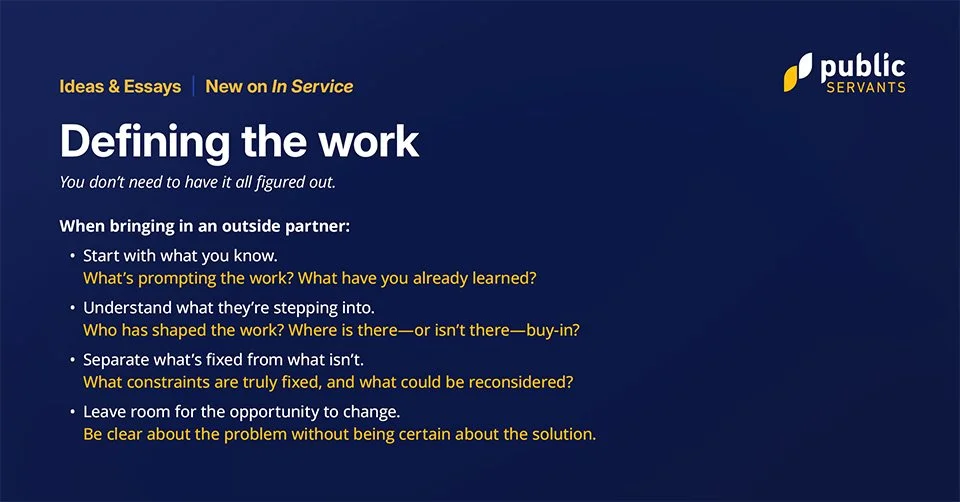
You can bring clarity to the work without having every answer. Start with what you know, understand the context, and leave room for the right partner to help shape what comes next.
Ready to define what comes next?
Whether you have a detailed brief or are still figuring out what the work should be, we can help you find a path forward.