Government services
How government meets people’s needs and carries out public responsibilities.
Government services are all around us. We rely on them when we turn on the tap, travel down a road, visit a library, register to vote, call for help in an emergency, apply for a permit, or check whether a restaurant is safe to eat in.
Some are highly visible, while others work best when we barely have to think about them.
At their broadest, government services are the programs, systems, infrastructure, resources, and interactions through which governments meet public needs, carry out public responsibilities, and help people exercise their rights and responsibilities.
That makes the term much bigger than the websites, forms, and benefits programs that often come to mind when we talk about improving government services.
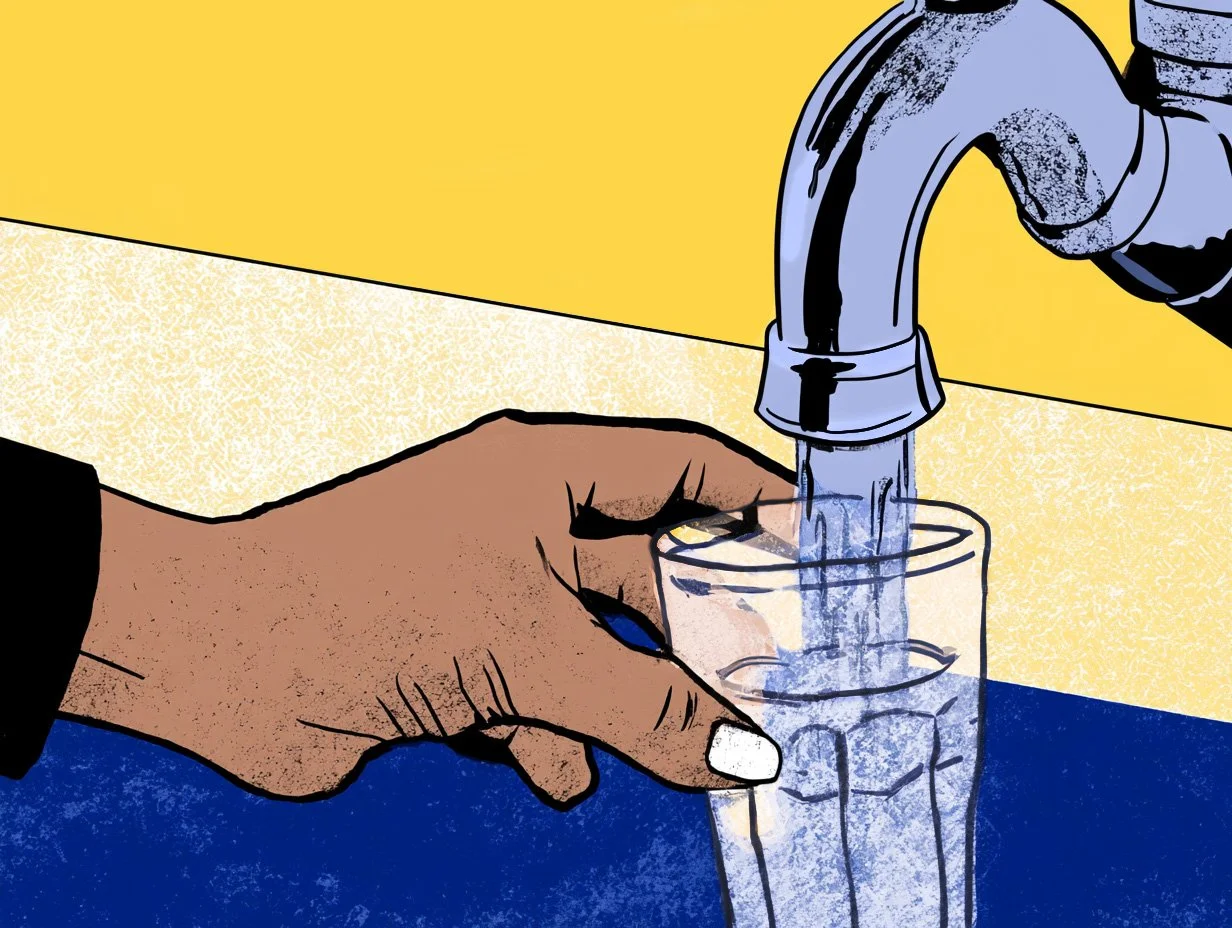
A glass of clean water can be a government service, made possible by systems and infrastructure most of us rarely see.
What counts as a government service?
A government service might help someone renew a driver's license, apply for housing assistance, start a business, obtain a passport, or request a public record.
But government services also include maintaining streets and public spaces, collecting waste, supplying clean water, operating public transit, conducting elections, inspecting buildings and restaurants, responding to emergencies, maintaining public records, and protecting public health.
Some services are transactional: a person needs to accomplish something and government provides a way to do it.
Others are informational, helping people understand their rights, responsibilities, opportunities, or risks.
Still others are protective, regulatory, infrastructural, or ongoing. You don't have to submit an application to benefit from clean drinking water, an inspected building, a functioning traffic signal, or emergency preparedness.
Thinking broadly about government services matters because it changes what we understand service quality to mean. A good government service isn't simply a good website or an easy form. It is about how effectively government fulfills a public responsibility for the people and communities it serves.
Where policy becomes experience
Policies describe what government intends, requires, permits, or provides. Government services put many of those decisions into practice.
A housing policy might become an application, eligibility determination, inspection, payment, or appeal.
A public health responsibility might become a vaccination clinic, restaurant inspection, emergency notice, or environmental health program.
A commitment to democratic participation might become voter registration, election information, accessible polling places, and ballot administration.
In each case, the public experiences more than the policy itself. People encounter the systems built to carry it out. That means the success of a policy depends in part on whether the services implementing it actually work for the people they are intended to reach.
That experience can determine whether someone understands what is available to them, can successfully access it, knows what is expected of them, and understands what happens next.
A service is more than the part we see
What people see of a government service is often only a small part of what makes it work.
Someone applying for a permit online might encounter a website, form, payment screen, a few emails, and eventually an approval or denial. Behind those interactions may be legislation, regulations, agency policies, staff workflows, databases, payment systems, accessibility requirements, communications, and coordination across multiple offices.
What feels like a single interaction to the public is often the visible edge of a much larger system.
That's one reason improving government services can't always begin and end with redesigning a website or rewriting a form. Sometimes the most consequential improvements happen behind the scenes—in policy, operations, staffing, technology, or coordination. Problems people encounter at the surface may originate much deeper in the service.
A confusing question might reflect an unclear policy. A long wait might result from a staffing or workflow constraint. A person repeatedly submitting the same information might be navigating systems that cannot exchange data. A beautifully designed digital experience may still fail someone who needs to access the service by phone or in person.
Understanding the experience and the systems producing it matters.
What feels like a single interaction to the public is often the visible edge of a much larger system.
People don't experience an org chart
Government is organized into departments, agencies, offices, jurisdictions, and levels. People's lives generally aren't.
Someone trying to care for an aging parent, recover after a disaster, open a small business, or find stable housing may encounter multiple agencies, levels of government, nonprofit organizations, and private companies along the way. Nonprofits and other community organizations may also help deliver government-funded services, connect people to them, or help people navigate systems that would otherwise be difficult to access.
From the institution's perspective, those may be separate programs with separate owners. From the person's perspective, they can be parts of the same need.
This is one reason public-centered services require looking beyond organizational boundaries. Improving one interaction can help, but sometimes the larger opportunity is making the pieces work better together.
It also means recognizing that not every relationship between a person and a government is the same.
In the United States, Tribal Nations are sovereign governments, not simply communities or stakeholder groups receiving services from federal, state, or local agencies. Tribal governments provide services to their citizens and communities, while the federal government provides some programs and services for Tribal Nations and Native people in connection with treaties, federal law, and the federal trust responsibility.
So what might look administratively like government providing a service can also represent the fulfillment of a right, treaty obligation, or government-to-government responsibility.
Public-centered service therefore requires more than inviting people to participate in a process. It requires understanding the nature of the relationship itself, including questions of authority, rights, responsibilities, history, and self-determination.
What makes a government service work well?
Strong government services help people successfully get what they need or fulfill what is required of them.
There’s no single formula for doing that well. A building inspection serves a different purpose than a public library, just as an emergency alert does from a benefits application.
That means asking questions such as:
Can people find and understand the service?
Is it accessible to people with different disabilities, languages, technologies, and circumstances?
Are we asking people for information we actually need?
Is the process proportionate to what someone is trying to accomplish?
Can people use an appropriate channel, whether online, by phone, through the mail, or in person?
Do people understand what will happen, how long it might take, and what they can do if something goes wrong?
Does the service respect people's time, privacy, autonomy, and dignity?
Are the systems and people behind the service equipped to deliver it reliably?
Have the people and communities who use or depend on the service had meaningful influence over how it works?
A service can technically exist without being meaningfully accessible to the people it is intended to serve.
And a service can function exactly as its designers intended while still creating unnecessary burdens for the people using it.
Services shape our relationship with government
For many people, a government service may be one of their most frequent direct interactions with a public institution.
Those experiences provide information about the institution behind them: whether it understands people's circumstances, respects their time, communicates clearly, follows through, and can reliably perform the responsibilities entrusted to it.
Not every frustrating experience can be solved through better design. Government services operate within laws, budgets, staffing realities, aging technologies, political decisions, and competing public needs.
But those constraints also make it important to understand where improvements are possible.
A clearer letter might prevent thousands of unnecessary phone calls. Research might reveal that a process designed around internal assumptions doesn't reflect how people actually navigate it. Better coordination between teams might eliminate repeated steps. An accessibility review might identify barriers preventing people from using a service at all.
Small changes can matter. So can rethinking the larger system.
Improving government services
At Public Servants, we work with public institutions and organizations that serve the public to understand how services operate today and how they could work better for the people and communities who depend on them.
That can mean researching people's experiences and needs, examining the systems and processes behind a service, improving communications and content, designing digital or physical interactions, bringing affected communities into the work, or helping teams align around a better approach to delivery.
Because improving a government service rarely begins and ends with a website, form, or individual interaction.
It means understanding the people, policies, processes, technologies, relationships, and institutions that make the service possible—and designing them to work better together.