Designing for crisis and resilience
How public-centered design helps governments and nonprofits prepare for, respond to, and recover from crisis.
Public service doesn’t get to choose its moment.
Increasingly, it operates under conditions of strain—climate-driven disasters, public health emergencies, ecological breakdown, aging infrastructure, political volatility. These are no longer edge cases or once-in-a-generation disruptions. They are the environment.
When everything is stressed at once, systems reveal what they were built to do—and who they were built to protect.
Design matters here. Not as decoration. Not as optimism. But as an act of responsibility.
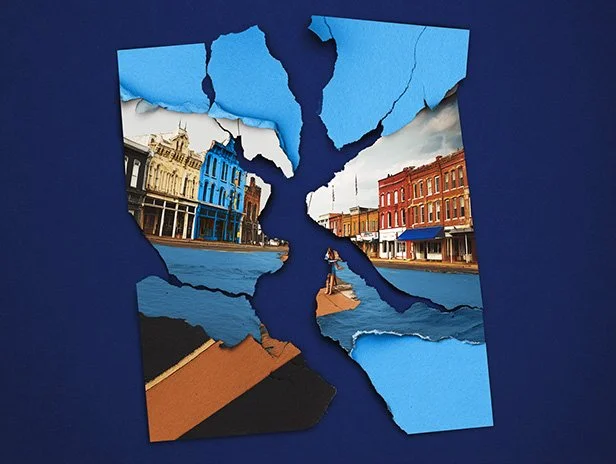
A visual metaphor for public systems under stress—fragmented, interdependent, and still capable of repair.
Values revealed by crisis
Crisis has a way of clarifying values.
When systems fail, they rarely fail evenly. The burden concentrates—on people with the least room to maneuver and the fewest buffers against disruption. Disabled people navigating emergency responses never designed for access. Elders isolated by transportation or digital barriers. Families living closest to environmental risk. Workers without paid leave or savings. Communities that know, from experience, that help may arrive late—or not at all.
Crisis does not distribute harm evenly. Design decides who absorbs it.
These outcomes are not accidents. They are the result of decisions, often made quietly long before crisis arrives, about who is centered, who is optional, and whose suffering is normalized.
Design choices distribute clarity, safety, and agency. They also distribute confusion, exposure, and harm. In moments of crisis, those distributions become unmistakable.
This is why equity is not an add-on in crisis work. It is not a secondary concern to be addressed “once things stabilize.” It is the measure of whether design is doing its job at all.
Crisis’ cyclical pattern
One of the most persistent misunderstandings about crisis work is that it begins with response.
In reality, crisis unfolds across a long arc that often repeats. Design shapes what happens long before an emergency is declared, and long after public attention fades.
Prevention rarely makes headlines, but it is where the most lives are protected. It lives in policies that reduce environmental and health risk, in infrastructure designed for future conditions rather than past ones, in education and preparedness that lower the chance of catastrophe in the first place. Prevention also asks difficult questions about what harm we are willing to tolerate—and for whom.
Resilience is not strength—it is systems that bend without abandoning people.
Mitigation comes into focus once systems are stressed. Here, clarity becomes as important as speed. Trauma-informed communication, redundancy that allows systems to fail without collapsing, and service delivery that respects human limits all determine the severity of impact. Resilience, in this sense, is not about strength. It is about flexibility.
Response is the most visible—and unforgiving—phase. But it is also where design must be most grounded in reality. People navigating crisis are not calm users. They are operating under fear, grief, exhaustion, and partial information. Systems that assume ideal behavior fail quickly, often in ways that deepen harm.
Recovery, finally, is where many systems break their promises. Once immediate danger passes, urgency fades. Old patterns reassert themselves. Too often, recovery is treated as restoration—returning systems to the same conditions that allowed harm to occur. Designing for recovery asks something more difficult: learning, adaptation, and the courage to rebuild toward something better, not merely familiar.
Crisis intervention phases
Prevention
Reducing exposure to harm before it becomes visibleMitigation
Limiting severity when systems are under stressResponse
Supporting action under fear, confusion, and constraintRecovery
Rebuilding toward durability—not familiarity
In practice, these phases overlap. Skipping any one of them shifts harm onto the public.
Seeing clearly, before imagining better
Design begins with seeing.
In crisis work, that means seeing harm clearly, without euphemism. Seeing inequality as structural rather than incidental. Seeing constraints—political, fiscal, ecological—not as inconveniences to design around, but as forces that shape what is possible.
This kind of observation is not pessimism. It is integrity.
Hope that is disconnected from reality is not hope; it is avoidance. The kind of hope design can responsibly offer is grounded—earned through evidence, proximity to lived experience, and a willingness to name what is broken.
From there, design can do what it does best: hold truth and possibility at the same time. Envision futures that are better without pretending they are easy. Futures shaped by ecological limits, political reality, and a commitment to dignity—not efficiency alone.
Design as stewardship, not authorship
History is full of examples of people who designed for crisis and resilience without ever claiming the title.
Rachel Carson reshaped public understanding of ecological systems by making invisible harm impossible to ignore. She framed environmental degradation not as an abstract tradeoff, but as a public failure of care—insisting on prevention long before its consequences became irreversible.
Temple Grandin transformed industrial cattle handling by designing from sensory reality rather than assumption. By observing systems from the subject’s point of view, she reduced unnecessary harm and improved outcomes at scale—demonstrating how empathy, when disciplined and evidence-based, becomes operational.
Franklin D. Roosevelt is often cited for orchestrating a federal response to economic collapse through the New Deal. That scale of intervention mattered. But such systems did not design themselves, nor did they reach everyone by default.
Mary McLeod Bethune shaped how recovery actually touched people’s lives. Operating outside formal power, Bethune translated the lived realities of Black communities into federal influence—building educational institutions, economic pathways, and access where exclusion had been normalized. Her work reminds us that resilience is co-produced, often under unequal conditions, by those who design at scale and those who persistently intervene in how systems behave.
None of them centered design as a profession. All of them practiced it as stewardship.
Designing for responsibility
Designing for crisis and resilience asks something different of those working in and alongside public systems.
It asks for humility over heroism. Preparation over reaction. Stewardship over novelty. Proximity to harm rather than distance from it.
Most of all, it asks us to design for people who cannot afford failure.
Public-centered design exists for moments when the margin for error disappears—when clarity, care, and trust are not abstractions, but lifelines. When systems must work not at their best, but under strain.
Designing for crisis is not about control.
It is about responsibility.
If this reflection feels connected to your work, you may also want to explore:
What public-centered design means—an introduction to designing public systems around people, not just processes
How public servants build trust, Trust as the new infrastructure, and the free Trust Signals Scorecard—a practical companion for strengthening trust in public systems
Timely interventions for public services—on why when interventions come matters as much as what they are
Designing policy that doesn’t break delivery—bridging intent and implementation
The policy implementation gap—and how design can help close it
If you’re grappling with these questions in your own work, Public Servants supports governments and nonprofits in designing public systems that hold under pressure—with care, clarity, and accountability.